📞  — free, 24/7
— free, 24/7 — free, 24/7| Package | Price per Dose | Price | |
|---|---|---|---|
| 180 pills | $1.93 | $409.26 $347.87 Free shipping | |
| 120 pills | $2.37 | $334.84 $284.62 Free shipping | |
| 90 pills | $2.81 | $297.64 $252.99 Free shipping | |
| 60 pills | $3.16 | $223.22 $189.74 | |
| 30 pills | $3.51 | $124.00 $105.40 | |
| 180 pills | $2.90 | $613.90 $521.81 Free shipping | |
| 120 pills | $3.16 | $446.46 $379.49 Free shipping | |
| 90 pills | $3.51 | $372.05 $316.24 Free shipping | |
| 60 pills | $3.95 | $279.03 $237.18 Free shipping | |
| 30 pills | $4.74 | $167.41 $142.30 |
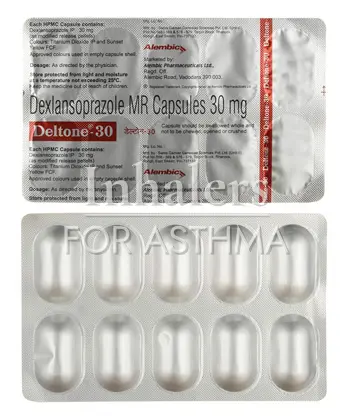
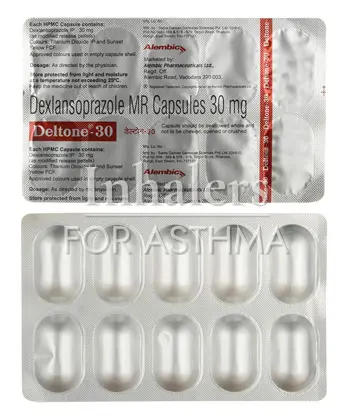
Dexlansoprazole is a proton pump inhibitor (PPI) of the benzimidazole class. It inhibits the H+/K+-ATPase (gastric proton pump) in parietal cells, producing sustained acid suppression; it is indicated for the treatment of gastroesophageal reflux disease (GERD) and for the healing and maintenance of erosive esophagitis.
Dexlansoprazole is the single active enantiomer of lansoprazole and is formulated to deliver two distinct release peaks. This dual delayed-release mechanism provides a prolonged and greater duration of gastric acid suppression than conventional PPIs, enabling once-daily dosing in many regimens. Pharmacodynamically, the drug rapidly inhibits the proton pump once activated in acid-secreting parietal cells, reducing basal and stimulated acid secretion.
As with other PPIs, the onset of full antacid effect may take several days for symptomatic GERD, though some patients experience improvement earlier. Dexlansoprazole undergoes hepatic metabolism and is excreted primarily via the fecal route, with renal clearance contributing to a lesser extent. Dose adjustments are not routinely required for age alone, but hepatic function may modulate exposure in severe impairment.
In clinical practice, dexlansoprazole is employed for adults with GERD presenting with erosive esophagitis and for maintenance therapy to prevent recurrence after healing. It is also used to manage troublesome heartburn associated with GERD, including non-erosive forms as guided by care providers. As with other PPIs, concomitant therapy should be evaluated for potential drug interactions and cumulative acid suppression effects.
Dexlansoprazole is indicated for healing and maintenance of erosive esophagitis in adults with GERD. By suppressing acid, it promotes mucosal healing and provides symptomatic relief from heartburn and regurgitation. The dual-release profile allows a 24-hour window of acid suppression, supporting once-daily dosing in many regimens.
It is used for the management of GERD symptoms in patients who have not achieved adequate control with lifestyle measures alone or with other non-prescription therapies. In clinical practice, dexlansoprazole may be chosen for patients who require reliable nocturnal acid suppression or who have had favorable tolerability with PPI therapy in the past.
Long-term maintenance therapy with a PPI such as dexlansoprazole aims to reduce the risk of relapse in patients with a history of erosive esophagitis or troublesome reflux symptoms. Treatment choices should consider the balance between symptom control and the risks associated with chronic acid suppression, including effects on nutritional absorption and infection risk.
Contraindications include known hypersensitivity to dexlansoprazole or to other benzimidazole medications. If a patient has had an immediate or delayed hypersensitivity reaction to a PPI, alternative non-PPI therapies should be considered and cross-reactivity avoided unless directed by a clinician.
precautions include the following: in patients with hepatic impairment, liver function should be monitored, and use should be conservative with severe impairment due to limited data on safety in this subgroup. Although dose adjustment is not routinely required for mild-to-moderate disease, clinicians should assess exposure and tolerability in severe hepatic disease.
During prolonged therapy, long-term PPI use has been associated with hypomagnesemia; symptomatic or asymptomatic hypomagnesemia may occur after prolonged exposure and may necessitate monitoring and magnesium supplementation or discontinuation of therapy. Vitamin B12 deficiency has been reported with extended PPI use due to impaired absorption; clinicians should evaluate and correct nutritional status as clinically indicated.
There is an established association between chronic acid suppression and emergence of enteric infections, notably Clostridioides difficile–associated diarrhea. Patients presenting with persistent or worsening diarrhea during PPI therapy should be evaluated for infection and managed accordingly. In some cases, PPI therapy may require temporary interruption or modification.
Gastric malignancy must be considered in patients with persistent upper abdominal symptoms, especially if there are red flags or unexpected weight loss; acid suppression should not delay investigation for potential gastric pathology. In elderly or frail patients, assessment of fracture risk and falls, particularly with repeated courses, may be prudent given potential effects on calcium absorption and bone health.
Pregnancy and lactation should be considered on an individualized basis. Data in pregnant or lactating individuals are limited; use only if clearly needed and after evaluation of potential benefits versus risks. In all populations, patients should be counseled about reporting any new symptoms or signs suggesting adverse effects or interactions with concomitant medications.
Common adverse events include diarrhea, abdominal pain, nausea, and flatulence. Headache and upper respiratory tract infections (such as sinusitis or pharyngitis) are frequently reported in patients receiving PPI therapy, including dexlansoprazole. Dizziness, GERD-related symptoms, and fatigue are also observed with mixed frequency across populations.
Less common adverse events include rash, pruritus, dry mouth, and back pain. Some patients may experience abdominal distension, vomiting, or dyspepsia despite therapy. Rare events include transaminase elevations or hypersensitivity reactions such as angioedema or anaphylaxis, requiring immediate medical assessment and discontinuation if confirmed.
Serious but infrequent complications associated with long-term PPI use include hypomagnesemia and vitamin B12 deficiency, as noted, and potential kidney injury or interstitial nephritis in susceptible individuals. Clinicians should promptly evaluate unusual, persistent, or severe symptoms and perform appropriate laboratory testing where indicated.
Dexlansoprazole can alter the absorption of medications that require an acidic gastric environment. Agents such as ketoconazole, itraconazole, and posaconazole may have reduced bioavailability when coadministered with PPIs. Iron salts, calcium carbonate, or other mineral supplements may be less effectively absorbed if taken with the PPI, potentially requiring separation of dosing times.
Antiretroviral therapies and other drugs reliant on gastric acidity for absorption may be affected. For example, some protease inhibitors (e.g., atazanavir, nelfinavir) and certain non-nucleoside reverse transcriptase inhibitors may show reduced absorption with acid suppression. When these combinations are clinically necessary, dose timing or regimen adjustments should be considered and monitoring undertaken.
Clopidogrel has been studied for potential interactions with PPIs; evidence is mixed regarding impact on antiplatelet effectiveness. Clinicians should weigh cardiovascular risk and monitor outcomes if concomitant clopidogrel and dexlansoprazole are necessary. High-dose methotrexate and other drugs with pH-dependent absorption may require monitoring for altered exposure in the presence of PPI therapy.
Dexlansoprazole is metabolized by hepatic cytochrome P450 pathways (notably CYP2C19 and CYP3A4). Concomitant use with strong inhibitors or inducers of these enzymes may affect dexlansoprazole levels and, conversely, could alter exposures of concomitant substrates. In patients receiving multiple interacting medications, a clinician may consider alternative regimens or closer pharmacovigilance.
14–21 days. Free from $200.00 .
5–9 days. $30.00
−10% when paying with cryptocurrency.
−10% on all repeat orders.
All orders are packed in neutral, unbranded boxes with no product name on the outside.